
Accumulator Bet: The Complete Guide to Winning Big (Without the Heartbreak)
 Available in US
Master accumulator betting with our complete guide. Learn calculations, strategies, and insider tips to maximize wins. Avoid costly mistakes—start smart today!

Table of Contents
- Accumulator Bet: Why Accumulators Are the Most Popular Bet Type
- What Is an Accumulator Bet? (Breaking It Down Simply)
- How Accumulator Bets Work (The Mechanics You Need to Know)
- Types of Accumulator Bets (Find Your Perfect Match)
- The Mathematics Behind Accumulator Betting (Why Bookies Love Them)
- How to Calculate Accumulator Odds (Master the Formula)
- Best Sports for Accumulator Betting (Where Smart Money Goes)
- Accumulator Betting Strategy (How to Actually Win)
- Accumulator Insurance & Bonuses (Free Money From Bookies)
- Common Accumulator Betting Mistakes (And How to Avoid Them)
- Accumulator Bet: Summary and How to Place Your First Smart Acca
- FAQ
Accumulator Bet: Why Accumulators Are the Most Popular Bet Type
Picture this: It’s Saturday afternoon, and you’re watching the final match of your accumulator bet. Nine teams have already won. Nine out of ten. You’re minutes away from turning your tenner into four grand. Your heart’s racing. You can already taste that victory. Then, in the 89th minute, the unthinkable happens. Your last team concedes an equalizer. The bet’s dead. Four thousand quid evaporates into thin air.
We’ve all been there. That sinking feeling when you realize you got so close, yet walked away with absolutely nothing. It’s the cruel beauty of accumulator betting massive rewards balanced precariously on the edge of total collapse. One mistake, one unlucky bounce, one referee decision, and your whole bet crumbles.
But here’s the thing: accumulator bets aren’t just about luck. Sure, you need things to go your way, but smart bettors know how to stack the odds in their favor. They understand the mathematics behind why bookies push these bets so hard. They pick the right markets that give them an edge. They use strategies that bookmakers don’t want you to know about.
This guide will transform how you approach accumulator betting. You’ll learn why bookmakers absolutely love these bets (spoiler: it’s not because you’re winning). You’ll discover the optimal number of selections that balances risk and reward. And you’ll understand exactly when to place an acca and when to walk away, saving yourself from those heartbreaking near-misses.
Whether you call them accumulators, accas, parlays, or multiples, by the end of this article, you’ll know how to build winning bets that actually have a fighting chance. We’re not promising you’ll win every time that’s impossible. But you’ll be armed with the knowledge that separates casual punters from serious bettors.
No BS, no fluff, no generic betting advice you’ve heard a million times. Just practical strategies that work in the real world.
Ready to stop losing and start winning? Let’s dive in.
What Is an Accumulator Bet? (Breaking It Down Simply)
An accumulator bet or “acca” if you’re from the UK, “parlay” if you’re American is a single bet that combines multiple selections into one wager. Simple enough, right? But here’s the catch that changes everything: every single selection must win for you to get paid. Miss one, and you get nothing. Zero. Zilch. The whole bet loses.
Think of it like building a house of cards. Each selection is another card you’re carefully stacking on top. The higher you build, the more impressive (and valuable) it becomes. But one wrong move, one gust of wind, one shaky hand, and the entire structure collapses. That’s accumulator betting in a nutshell.
Let’s break down a basic example that’ll make it crystal clear. Say you fancy Manchester United to beat Fulham at 1.5 odds, Arsenal to beat Tottenham at 1.7 odds, and Liverpool to beat Everton at 1.6 odds. Instead of placing three separate £10 bets (£30 total), you combine them into one accumulator with just a £10 stake. If all three teams win, your returns aren’t just added together they’re multiplied. That’s where the magic happens. Your £10 stake becomes £40.80 (1.5 × 1.7 × 1.6 × £10).
The word “accumulator” perfectly describes what’s happening under the hood. Your odds accumulate. They multiply together, creating potentially massive returns from relatively small stakes. A fiver can become five hundred quid if you pick right. A tenner can turn into thousands. But and this is the part bookmakers love that multiplication works both ways. Your chances of winning also multiply… in the wrong direction.
Here’s what makes accumulators fundamentally different from other bets. With a single bet, you’re putting your money on one outcome. Win or lose, it’s straightforward. You either get paid or you don’t. With an accumulator, you’re essentially saying “I’m so confident in all these selections that I’m willing to risk everything on them all coming through.” It’s betting’s equivalent of going all-in at a poker table.
Different regions have different names for exactly the same bet, which confuses plenty of newcomers. In the UK and Ireland, everyone calls them accumulators or accas. Americans prefer parlay. Europeans might say multiple bet or combo bet. Australians call them multis. But no matter what you call them, the mechanics are identical multiple selections, single stake, all must win. Same bet, different name.
The appeal is blindingly obvious. Small stake, massive potential payout, and the thrill of watching multiple events unfold knowing your entire bet rides on every single one. When you win, you feel like an absolute genius who’s cracked the code. When you lose well, there’s always next Saturday, right?
How Accumulator Bets Work (The Mechanics You Need to Know)
Right, let’s get into the nuts and bolts of how these bets actually function. Understanding the mechanics isn’t just academic it’s the difference between making informed bets and throwing money away blindly.
When you place an accumulator, you’re essentially creating a chain reaction. Your stake goes on the first selection. If it wins, your returns (stake plus profit) automatically roll onto the second selection. If that wins, everything rolls onto the third. And so on, until either you hit the jackpot or one selection loses and breaks the chain completely.
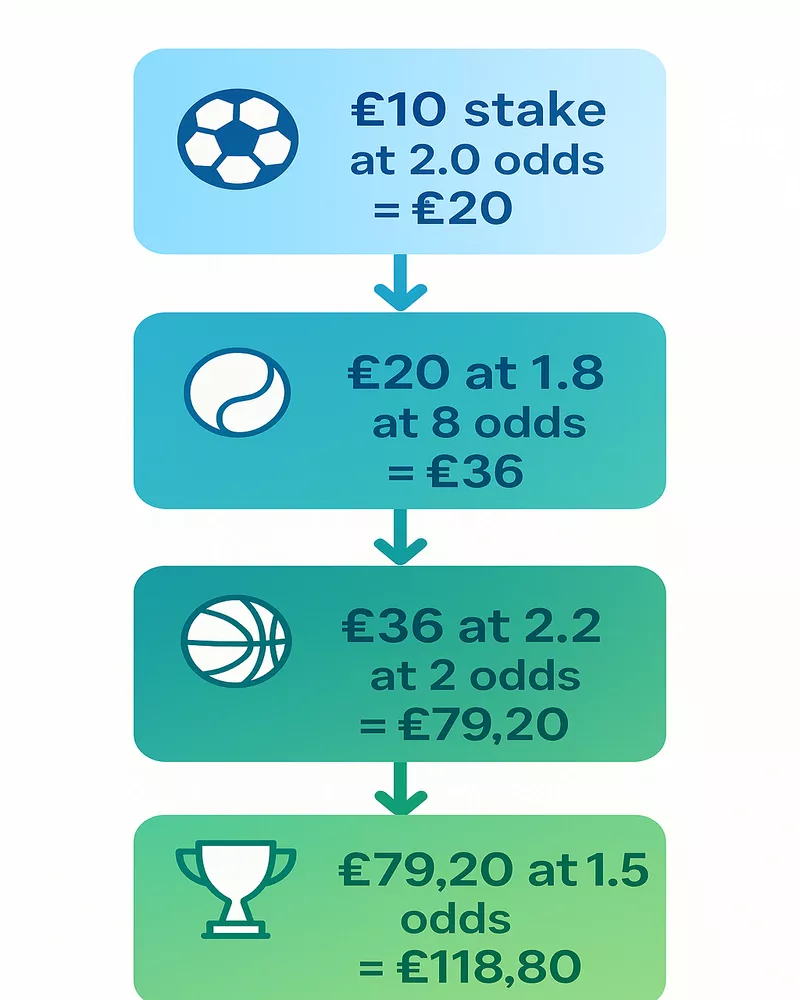
Here’s a step-by-step walkthrough. You place a four-fold accumulator with £10 on these selections:
- Team A to win at 2.0 odds
- Team B to win at 1.8 odds
- Team C to win at 2.2 odds
- Team D to win at 1.5 odds
First leg: Team A wins. Your £10 becomes £20 (£10 stake × 2.0 odds). But you don’t pocket that twenty quid it automatically moves to the next selection.
Second leg: Team B wins. That £20 becomes £36 (£20 × 1.8 odds). Again, it rolls forward without you touching it.
Third leg: Team C wins. Your £36 becomes £79.20 (£36 × 2.2 odds). You’re flying now. One more to go.
Fourth leg: Team D wins. Your £79.20 becomes £118.80 (£79.20 × 1.5 odds). That’s your final return nearly twelve times your original stake from a single tenner.
But what if Team C had lost in the third leg? Everything up to that point becomes utterly worthless. Your £36 from the first two legs? Gone. Evaporated. The bet’s dead, even though two teams won exactly as you predicted. This all-or-nothing nature is what makes accumulators simultaneously thrilling and absolutely brutal.
Now, bookmakers make this process seamless on their platforms. You don’t actually place four separate bets manually, reinvesting your winnings each time. You select your picks, tick the “accumulator” option on your bet slip, and the bookmaker calculates your total odds automatically. Your potential return appears instantly. In our example: 2.0 × 1.8 × 2.2 × 1.5 = 11.88 combined odds. Multiply that by your £10 stake, and you get £118.80 potential return.
What happens with void selections? Say one of your matches gets postponed before kick-off because of bad weather. That leg is removed from your accumulator, and your bet continues with the remaining selections at adjusted odds. A five-fold becomes a four-fold. Your potential winnings drop significantly, but at least the bet survives. This is actually one of the few times accumulators show you mercy.
Dead heats are trickier. In horse racing, if two horses tie for first place, your odds are halved for that selection. It doesn’t void the leg completely it just reduces your potential return significantly. Not ideal, but better than a total loss.
Most bookmakers don’t allow correlated selections in accumulators. You can’t bet on Manchester United to win and “both teams to score” in the same match within one acca. Why? Because these outcomes influence each other. If United are winning, it affects the probability of both teams scoring. Bookies aren’t stupid they block these attempts.
The beauty of understanding these mechanics is that you can start calculating value before placing your bet. If you know how the multiplier works, you can spot when odds are genuinely favorable and when you’re being sold a lemon dressed up as an opportunity.
Types of Accumulator Bets (Find Your Perfect Match)
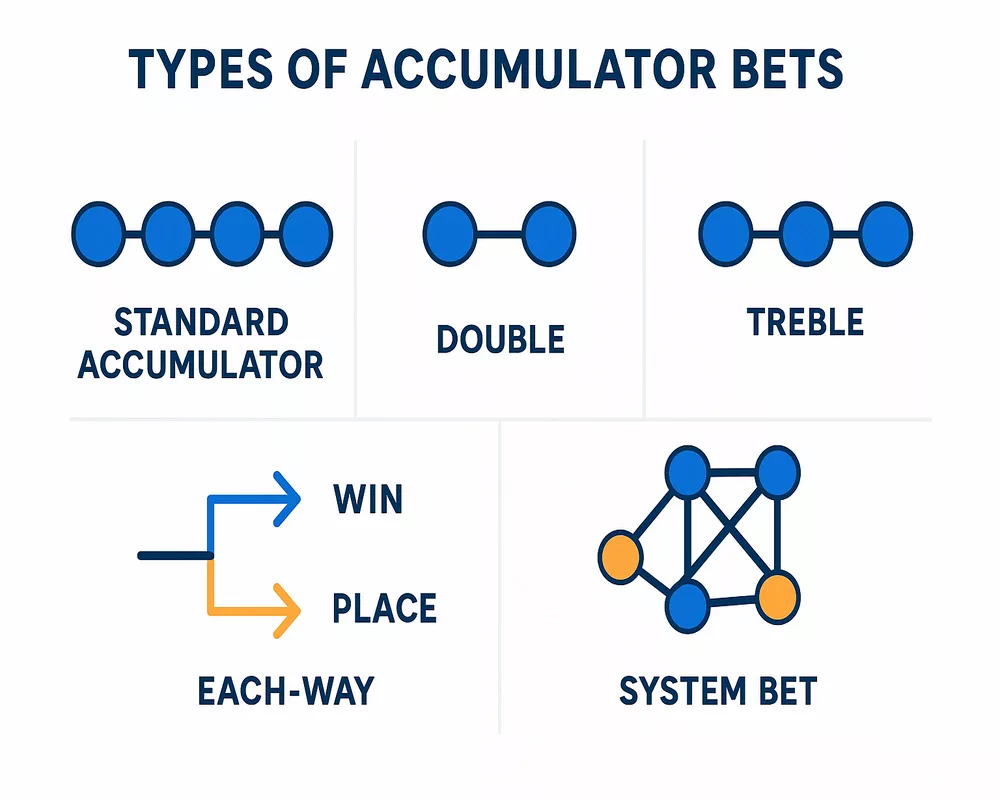
Not all accumulators are created equal. There’s actually a whole spectrum of bet types that fall under the accumulator umbrella, each with different risk profiles and potential rewards. Knowing which type to use in which situation can transform your betting.
Standard Accumulator (Four or More Selections)
This is what most people think of when they hear “accumulator.” Four or more selections, all must win, odds multiply together. It’s the high-risk, high-reward classic. You’ll hear these called four-folds, five-folds, six-folds, and so on, depending on how many selections you include. The name just refers to the number of legs.
Most bookmakers require at least four selections before they’ll officially call it an accumulator for promotional purposes. This isn’t arbitrary it’s because the odds of winning drop significantly once you pass three selections, which is exactly what bookies want.
Doubles and Trebles (The Accumulator’s Smaller Cousins)
Technically, these are accumulators too just with fewer selections. A double combines two selections. A treble combines three. Same multiplication principle, same “all must win” rule, but with better chances of actually winning because there’s less that can go wrong.
Doubles and trebles don’t get the same love as proper accumulators because the returns are more modest. But here’s a secret: serious bettors use them more often than big accumulators. Why? Because they actually win sometimes.
Each-Way Accumulator (The Safety Net)
Here’s where things get interesting. An each-way accumulator gives you two bets in one: a win accumulator and a place accumulator. This is mainly used in horse racing and golf, where “place” means finishing in the top positions (usually top three or four, depending on the field size).
The catch? Your stake doubles. A £10 each-way accumulator actually costs you £20. But if your horses don’t all win but they all place, you still get paid (though at reduced odds). It’s insurance against the all-or-nothing nature of regular accumulators.
System Bets (Built-In Insurance)
System bets are where accumulator betting gets sophisticated. Instead of one accumulator, you’re placing multiple smaller accumulators within your selections. Common system bets include:
- Trixie: Four bets from three selections (three doubles and one treble)
- Patent: Seven bets from three selections (three singles, three doubles, and one treble)
- Yankee: Eleven bets from four selections (six doubles, four trebles, and one four-fold)
- Lucky 15: Fifteen bets from four selections (four singles, six doubles, four trebles, and one four-fold)
System bets cost more because you’re placing multiple bets. But they offer built-in protection. If one selection loses in a Lucky 15, you’ve still got plenty of other bets that can win. It’s the opposite philosophy from a single accumulator.
Same Game Parlay / Bet Builder (The Modern Innovation)
This is a relatively new development in accumulator betting. You can now combine multiple selections from the same match into one bet. For example: Manchester United to win, over 2.5 goals, and Bruno Fernandes to score. These used to be banned because the outcomes are correlated, but bookmakers figured out how to price them correctly.
Same game parlays are massively popular because they let you bet on a single match in an accumulator format. You’re not spreading risk across different games you’re going all-in on one match having multiple specific outcomes. It’s incredibly risky, which is precisely why bookies love offering them.
The key is matching the bet type to your risk tolerance and strategy. Feeling conservative? Stick with doubles and trebles. Want that lottery-ticket thrill? Go for a ten-fold standard accumulator. Want some insurance? Try an each-way acca or a system bet. There’s no “correct” choice just different tools for different situations.
The Mathematics Behind Accumulator Betting (Why Bookies Love Them)
Time for some uncomfortable truth. Bookmakers absolutely adore accumulator bets, and it’s got nothing to do with them being generous. The mathematics of accumulators heavily favor the house in ways that aren’t immediately obvious.
Here’s what’s really happening. Every single bet you place with a bookmaker has a built-in margin the bookmaker’s edge. On a typical football match, this margin might be around 5-6%. That means for every £100 you bet over time, the bookmaker expects to keep £5-6 as profit.
Now, here’s where accumulators become a goldmine for bookies. That margin compounds with every selection you add. It’s not just five percent it multiplies through each leg of your accumulator. Add four selections together, and suddenly the bookmaker’s edge isn’t 5% anymore. It’s closer to 20-25%.
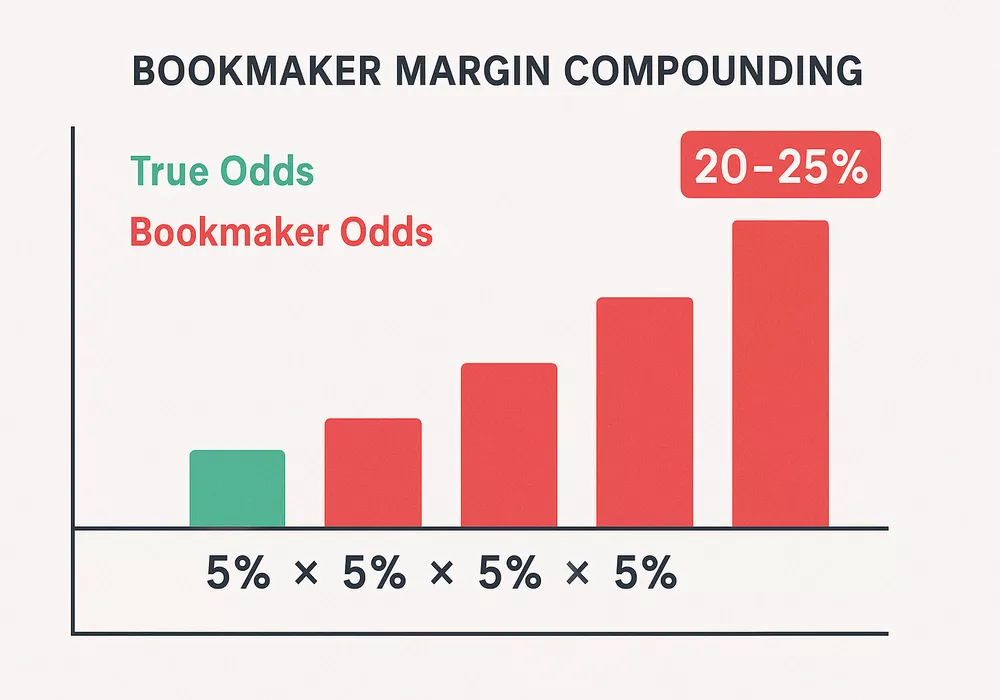
Let’s see this in action with numbers. You place a four-fold accumulator where each selection has 2.0 odds (evens). Seems fair, right? In a truly fair market with no bookmaker margin, each event should have exactly 50% chance of happening. Four 50% chances multiplied together give you a 1 in 16 chance of winning (50% × 50% × 50% × 50% = 6.25%).
So with true odds, your four-fold should pay out at 16.0. But the bookmaker offers you 2.0 × 2.0 × 2.0 × 2.0 = 16.0, which seems fair. Except those aren’t true 2.0 odds. The bookmaker has already factored in their margin on each leg. The real probability isn’t 50% it’s probably closer to 52-53% once you account for the overround.
When you compound that across four selections, your true odds of winning might be something like 1 in 21 instead of 1 in 16. You’re getting paid 16.0 odds for something that should actually pay 21.0. That’s a massive difference.
This is exactly why bookmakers plaster accumulator promotions all over their advertising. “£5 gets you £5000!” they shout. What they don’t shout is that your actual chance of winning is far lower than the odds suggest because they’re taking a cut from every single selection.
Does this mean accumulators are unbeatable? Not necessarily. If you can identify genuine value in your selections bets where the bookmaker has underpriced the probability then combining them in an accumulator actually amplifies your edge. But that’s the hard part. Most punters aren’t finding value; they’re just combining random fancies and hoping for the best.
The psychological trap is brutal too. Adding “just one more selection” to boost your potential winnings feels like you’re getting more value. In reality, you’re handing more margin to the bookmaker with every leg you add. It’s the betting equivalent of taking another card when you’re already sitting on 19 in blackjack.
Here’s a rule of thumb that’ll save you money: if you’re making money on single bets with a particular strategy, accumulating those bets will amplify your profit. If you’re losing money on singles, accumulators will amplify your losses even faster. The multiplier works both ways.
How to Calculate Accumulator Odds (Master the Formula)
Calculating accumulator odds isn’t rocket science, but plenty of people get confused by it. Let’s demystify the process once and for all.
The basic formula is beautifully simple: multiply all your decimal odds together, then multiply by your stake. That’s it. No complex equations, no calculus required.
Here’s a practical example. You’ve built a four-fold accumulator with these selections:
- Manchester City to win at 1.4
- Liverpool to win at 1.6
- Arsenal to win at 1.8
- Chelsea to win at 2.0
Your combined odds: 1.4 × 1.6 × 1.8 × 2.0 = 8.064
If you stake £10, your potential return is £10 × 8.064 = £80.64. That’s £70.64 profit plus your £10 stake back.
Simple, right? But here’s where people mess up. They forget that decimal odds already include your stake. When you see 2.0 odds, that’s not double your money that’s your stake returned plus an equal amount in profit. So 2.0 odds on £10 gives you £20 total return (£10 stake + £10 profit), not £20 profit.
Fractional odds require an extra step. First, convert them to decimal. Take the fraction, divide it out, and add one. For example, 5/2 odds become (5÷2) + 1 = 3.5 in decimal. Then multiply as normal.
Most bookmakers display decimal odds by default these days, which makes life easier. But if you’re old school and prefer fractions, just remember to convert first. Trying to multiply fractions directly is asking for a headache.
American odds are a different beast entirely. Positive American odds like +150 convert to decimal as (150÷100) + 1 = 2.5. Negative American odds like -120 convert as (100÷120) + 1 = 1.83. Once you’ve converted everything to decimal, the multiplication is identical.
Now, do you actually need to do this manually every time? Absolutely not. Every bookmaker calculates your potential return automatically when you build your bet slip. The odds update in real-time as you add selections. You’ll see your potential payout before you confirm anything.
So why bother learning the formula? Two reasons. First, understanding the math helps you spot value. If you know what the combined odds should be, you can verify the bookmaker isn’t shorting you (rare, but it happens with system bets). Second, it helps you make smarter decisions about whether to add another selection. You can see instantly how much adding one more leg actually improves your potential return versus how much it reduces your probability of winning.
There are loads of free accumulator calculators online if you want to double-check bookmaker calculations or play around with different combinations. They’re particularly useful for more complex bets like each-ways or system bets, where the math gets messy quickly.
The golden rule: always understand what you’re betting on and what you’re getting paid. Don’t just blindly trust the numbers on your bet slip without grasping the logic behind them.
Best Sports for Accumulator Betting (Where Smart Money Goes)

Not all sports are created equal when it comes to accumulator betting. Some offer genuine opportunities, while others are specifically designed to separate you from your money as quickly as possible.
Football (The Accumulator King)
Football dominates accumulator betting, and for good reason. Multiple matches kick off simultaneously every weekend, giving you plenty of options to build your bet. The markets are liquid, the odds are competitive, and most importantly, you actually understand what you’re betting on.
The best football accumulator markets aren’t always the obvious ones. Match result (1X2) is popular, but it’s a three-way market where draws can kill your bet. Smart money often gravitates toward two-way markets:
- Both Teams to Score (BTTS): Only two outcomes yes or no. More predictable in certain matchups.
- Over/Under 2.5 Goals: Again, two-way. Historical data makes this remarkably consistent across leagues.
- Asian Handicap: Removes the draw, giving you better odds and clearer outcomes.
Premier League Saturdays are accumulator paradise. Fifteen matches happening at 3pm, familiar teams, tons of statistical data. But beware bookmakers price these markets incredibly sharp precisely because they’re so popular.
Horse Racing (The Each-Way Haven)
Horse racing accumulators are a different beast entirely. The odds are generally longer, which means bigger potential payouts but lower win probability. This is where each-way accumulators really shine.
Major race days Cheltenham Festival, Royal Ascot, the Grand National are specifically built for accumulators. Bookmakers offer extra place terms, making each-way bets more attractive. You can get paid for horses finishing fourth or fifth in big handicaps, which transforms the risk profile completely.
The catch? Horse racing requires serious form analysis. You can’t just pick horses with cool names (though we’ve all done it). Track conditions, jockey form, distance preferences it all matters. If you’re not willing to do the homework, horse racing accumulators will drain your bankroll faster than a Derby winner sprinting for the line.
Tennis (The Two-Outcome Sweet Spot)
Tennis offers something beautiful for accumulator bettors: binary outcomes. Someone wins, someone loses. No draws. This simplicity makes probability calculations cleaner.
Grand Slam tournaments are accumulator goldmines. Loads of matches happening daily, clear favorite/underdog splits, and extensive head-to-head data. The early rounds are particularly interesting because lower-ranked players occasionally upset big names, offering value if you spot it early.
But tennis has a massive caveat: injuries and retirements. A player retiring mid-match usually voids that leg of your accumulator, reducing your odds. Some bookmakers are stricter and count retirements as losses. Check the terms before betting.
Sports to Approach Carefully
Basketball and American football work for accumulators, especially with point spread markets. The stats are abundant, and games happen predictably. But the margins are thin one garbage-time basket can swing a point spread bet.
Cricket accumulators are popular in certain markets, particularly in shorter formats like T20. But match conditions (weather, pitch) introduce massive variables that make consistent winning nearly impossible.
Sports to Avoid in Accumulators
Anything with tiny fields or massive favorites. Combat sports (boxing, MMA) rarely have enough simultaneous events to build proper accumulators. Snooker and darts can work for tournament outrights, but you’re essentially buying a very long-term lottery ticket.
The golden rule: stick to sports you genuinely understand. Your mate might win big on an eight-fold ice hockey accumulator, but if you don’t know the difference between icing and powerplay, you’re gambling pure luck.
Accumulator Betting Strategy (How to Actually Win)

Right, enough theory. Let’s talk about strategies that actually work in the real world. These aren’t magic formulas that guarantee wins, but they’ll dramatically improve your odds compared to blindly building accumulators based on gut feeling.
The Golden Rule: Four to Six Selections Maximum
Here’s where most punters go wrong. They see a potential £10,000 return from a ten-fold accumulator and convince themselves it’s worth a shot. It’s not. The probability of winning drops exponentially with each selection you add.
Four to six legs is the sweet spot. You get meaningful odds multiplication without completely destroying your win probability. Think about it mathematically: even if each selection has a genuine 70% chance of winning, a six-fold accumulator still only has a 12% overall win probability (0.7^6). Add four more legs, and you’re down to 2.8%. The extra potential winnings don’t compensate for the collapsed probability.
Focus on Two-Way Markets
Three-way markets (match result with win/draw/win options) are accumulator killers. You’re giving the bookmaker an extra outcome to beat you with. Instead, focus on markets with just two possible results:
- Both Teams to Score: Yes or No
- Over/Under Goals: Above or below a threshold
- Asian Handicap: Removes the draw completely
These markets might offer shorter odds per selection, but your overall probability of winning increases significantly. Remember, you need all legs to win. Better to get paid at lower combined odds than to lose everything to one unexpected draw.
Value Over Certainty
This sounds counterintuitive, but hear me out. Adding a 1.10 favorite to your accumulator might feel safe, but it’s often horrible value. You’re risking everything for a tiny return, and favorites lose more often than their odds suggest.
Instead, look for value selections in the 1.5 to 2.5 odds range. These are bets where you genuinely believe the probability of winning is higher than the odds imply. It requires research and analysis, but that’s the whole point. If you’re not finding value, you shouldn’t be betting.
Bankroll Management (The Unglamorous Truth)
Never stake more than 1-2% of your bankroll on a single accumulator. I know, it’s boring advice. But accumulators lose more often than they win by design. If you’re betting 10% or 20% of your bankroll on each acca, you’ll go broke before you hit your first winner.
Think of it like this: accumulators are lottery tickets with better odds. You want to buy enough tickets over time to eventually hit winners, but not so many on each ticket that one bad run destroys you completely. Consistency beats big swings.
Use Insurance Strategically
Many bookmakers offer accumulator insurance: if one leg loses, they refund your stake as a free bet. This changes the entire risk profile. Build your accumulators specifically to qualify for insurance (usually five or more legs with minimum odds), and suddenly you’ve got built-in protection against the most common scenario losing by exactly one leg.
The “lock-in” matched betting strategy takes this further. Lay each selection sequentially at a betting exchange as your accumulator progresses. If done correctly, you guarantee profit whether your accumulator wins or triggers the insurance. It’s more complex and requires an exchange account, but serious bettors use this approach religiously.
Cash-Out Wisely (Don’t Be Greedy)
If you’re three legs into a five-fold accumulator and sitting on a potential £200 return, sometimes it’s smart to cash out for £120 guaranteed rather than risking everything on the last two legs. The bookmaker’s cash-out offer is never generous, but having something is better than having nothing when luck turns.
That said, don’t cash out reflexively. Calculate whether the cash-out price actually makes mathematical sense compared to the true probability of your remaining legs winning. Bookmakers price cash-outs heavily in their favor.
The Research Advantage
Here’s what separates winners from losers: research. Not just checking the league table, but genuinely analyzing form, injuries, suspensions, historical head-to-head records, home/away splits, and even things like referee tendencies.
Sounds like work? That’s because it is. But if you’re not willing to put in that work, you’re not betting you’re gambling. There’s a difference.
When to Walk Away
Sometimes the smart play is not betting at all. If you can’t find genuine value selections, don’t force an accumulator just because it’s Saturday and there’s football on. Betting should be selective, not habitual.
Accumulator Insurance & Bonuses (Free Money From Bookies)
Bookmakers offer accumulator promotions for one reason: they’re hugely profitable for the house. But that doesn’t mean you can’t extract value from these offers if you know what you’re doing.
What Is Accumulator Insurance?
Accumulator insurance is simple: if your acca loses by exactly one leg, the bookmaker refunds your stake. Usually as a free bet rather than cash, but it’s still protection against the most common way accumulators die.
Typical requirements look like this:
- Minimum five or six selections
- Each selection must meet minimum odds (often 1/5 or 2/5)
- Combined odds usually need to be 3/1 or higher
- Only one leg can lose if two or more fail, no refund
- Maximum refund is capped (often £10-£50)
The beauty of insurance is it shifts the risk profile dramatically. Losing by one leg the most heartbreaking scenario now triggers a refund. You essentially get a second chance.
Accumulator Bonuses (When You Actually Win)
These work oppositely. If your accumulator wins, the bookmaker adds a percentage bonus to your winnings. The percentage increases with more selections:
- 5% for 5 legs
- 10% for 6 legs
- 15% for 7 legs
- Up to 100% for 15+ legs
Sounds generous, but here’s the trap: you need all selections to win. And we already know that probability collapses rapidly. Bookies can afford to offer 100% bonuses on fifteen-fold accumulators because almost nobody wins them.
How to Exploit These Offers
Build accumulators specifically to qualify for insurance. Stick to the minimum requirements usually five selections at qualifying odds. Don’t add extra legs just because. Each additional selection reduces your probability of winning and barely improves your insurance benefit.
For matched bettors, insurance offers are pure gold. The “lock-in” method involves laying each leg sequentially at a betting exchange. Done correctly, you lock in profit whether the accumulator wins or triggers insurance. It’s arbitrage masquerading as a promotion.
Read the Fine Print
Accumulator promotions come with more terms and conditions than a mortgage application. Which sports qualify? Which markets? Can you combine pre-match and in-play? Is there a maximum odds cap on individual selections?
Some bookmakers restrict insurance to football only. Others allow multiple sports. Some count correct score markets, others don’t. Always check before building your bet.
The free bet you receive from insurance often has its own restrictions too. Minimum odds requirements, time limits (usually 7 days), and the stake not being returned with winnings. Factor this into your value calculations.
Common Accumulator Betting Mistakes (And How to Avoid Them)
Learning from others’ mistakes is cheaper than making them yourself. Here are the errors that kill most accumulator bets before they even have a chance.
Mistake #1: Loading Up on Heavy Favorites
Throwing in Manchester City at 1.10 to beat a relegation candidate feels safe. It’s not. Favorites lose more than their odds suggest, and when they do, you’ve sacrificed potentially massive returns for minimal gain. Plus, you’ve added bookmaker margin to your bet for virtually no return improvement.
If a selection is below 1.30 odds, seriously question whether it’s worth including. The risk-reward rarely justifies it.
Mistake #2: Too Many Selections (Greed Kills)
We’ve hammered this point, but it bears repeating: more selections do not mean better value. Every leg you add multiplies the bookmaker’s edge against you. That twelve-fold accumulator with £50,000 potential return? Your actual probability of winning is essentially zero.
Stick to four to six selections maximum. If you’ve got ten bets you fancy, make two separate five-folds. Your overall probability of winning something increases dramatically.
Mistake #3: Ignoring Value
Picking teams based on name recognition or because “they always win at home” isn’t strategy it’s wishful thinking. Professional bettors obsess over value: finding bets where the true probability of winning is higher than the odds imply.
If you’re not calculating implied probability and comparing it to your own assessment, you’re flying blind. This means actual research, not just gut feeling.
Mistake #4: Mixing Correlated Events
Some punters try to sneak correlated selections past bookmakers. “Manchester United to win” and “Over 2.5 goals” in the same match, for example. Most bookmakers block this automatically, but even when they don’t, the odds are adjusted to account for correlation.
You’re better off keeping selections independent across different matches. The multiplication of genuine independent probabilities is powerful enough without trying to game the system.
Mistake #5: Chasing Losses
Lost your Saturday accumulator? The temptation to “win it back” with a bigger acca on Sunday is overwhelming. Don’t. Emotional betting compounds mistakes. Chase losses and you’ll simply lose faster.
Set a bankroll, stick to your unit sizes, and accept that most accumulators will lose. That’s the game. The winners pay for multiple losers, not the other way around.
Mistake #6: Betting on Wrong Markets
Correct score accumulators are basically lottery tickets. First goalscorer accumulators are even worse. These markets have massive bookmaker margins and incredibly low hit rates.
If you’re building accumulators for any chance of consistent success, stick to markets with reasonable probabilities: match result, BTTS, over/under goals, Asian handicap. Leave the exotic markets for fun bets with money you can afford to burn.
Mistake #7: Not Using Available Protection
If accumulator insurance is available and your bet qualifies, use it. It’s free protection against the most common loss scenario. Not taking advantage is leaving money on the table.
Similarly, if you’re deep into a winning accumulator and the cash-out offer is reasonable, at least consider it. Sometimes guaranteeing a solid profit is smarter than risking everything on the final leg.
Mistake #8: Betting Without Research
This is the fatal error that underlies all others. If you’re building accumulators based on team names, recent form, or what your mate down the pub said, you’re not betting you’re gambling.
Successful accumulator betting requires the same research intensity as single bets, multiplied by the number of selections. If you’re not willing to do that work, you’re better off finding a different hobby.
Accumulator Bet: Summary and How to Place Your First Smart Acca
Accumulator betting walks a razor’s edge between calculated risk and pure gambling. The difference isn’t luck it’s knowledge, discipline, and strategy.
You now understand why bookmakers push these bets so aggressively: the compounding margin works massively in their favor. You know that four to six selections is the sweet spot, balancing meaningful returns against realistic win probability. You’ve learned to focus on two-way markets, seek genuine value over perceived certainty, and use insurance offers to shift risk in your direction.
The truth about accumulators? They’re entertainment first, investment second. Most will lose. Accept that reality upfront. Your job isn’t to win every accumulator it’s to build bets with genuine mathematical advantage so that when you do win, the returns more than compensate for your losses.
Key takeaways to remember:
- Limit selections to four to six for optimal risk/reward
- Focus on value, not favorites or big names
- Use two-way markets to improve win probability
- Never stake more than 1-2% of bankroll per bet
- Exploit insurance offers when available
- Research every selection thoroughly no exceptions
- Know when to walk away from bad opportunities
The accumulator bettors who succeed long-term aren’t lucky. They’re selective, disciplined, and ruthlessly focused on value. They treat betting like a skill to develop, not a lottery to enter.
Will you hit that life-changing accumulator? Maybe. Maybe not. But with the strategies in this guide, you’ll at least give yourself a genuine fighting chance instead of handing your money to bookmakers on a silver platter.
Now get out there and build some winners. Just remember: the smart money knows when to say no.
FAQ
Q: What happens to my accumulator bet if one selection is void?
A: When a selection is void (due to postponement, non-runner, or cancellation), that leg is removed from your accumulator entirely. Your bet continues with the remaining selections at adjusted odds. For example, a five-fold accumulator becomes a four-fold. Your stake remains the same, but potential winnings decrease because you’ve lost one multiplier. Note: Some bookmakers handle this differently for ante-post markets, where non-runners may count as losers rather than void selections. Always check specific terms.
Q: Can you cash out an accumulator bet early?
A: Yes, most bookmakers offer cash-out functionality on accumulator bets. You can take a guaranteed payout before all selections finish, securing profit or minimizing losses. The cash-out value updates in real-time based on current odds and remaining legs. However, bookmaker cash-out offers are never generous they’re priced in the house’s favor. Calculate whether accepting the cash-out makes mathematical sense compared to letting your bet run. Sometimes it’s smarter to guarantee something rather than risk everything on remaining legs.
Q: What’s the minimum number of selections for an accumulator bet?
A: Technically, any bet with two or more selections can be called an accumulator. A two-selection bet is a “double,” three selections make a “treble,” and four or more are typically called accumulators (four-fold, five-fold, etc.). However, most bookmaker promotions especially accumulator insurance offers require at least four or five selections to qualify. The specific requirements vary by bookmaker and promotion, so check terms before building your bet.
Expertly verified: Mason Wright