
How to Calculate Accumulator Odds: Master the Math in 5 Minutes
 Available in US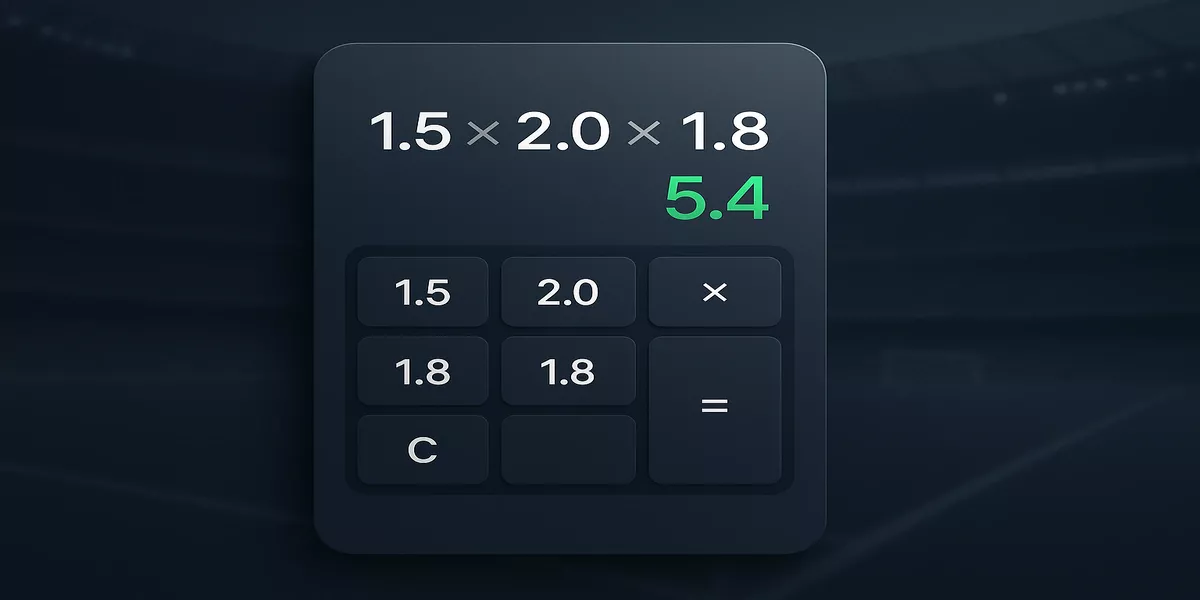
Table of Contents
- Calculate Accumulator Odds: Why Understanding the Math Gives You an Edge
- The Basic Accumulator Odds Formula (It’s Simpler Than You Think)
- Calculating Accumulator Odds with Decimal Odds (The Easiest Method)
- Calculating Accumulator Odds with Fractional Odds (The Traditional Way)
- American Odds in Accumulators (For US Bettors)
- Using an Accumulator Calculator (The Smart Shortcut)
- Accumulator Returns vs Single Bets (The Comparison That Matters)
- Common Calculation Mistakes Bettors Make
- Accumulator Odds Psychology (Why Big Numbers Seduce Us)
- Calculate Accumulator Odds: Summary and How to Use the Formula in Practice
Calculate Accumulator Odds: Why Understanding the Math Gives You an Edge
Let’s be honest-most people placing accumulator bets have absolutely no idea what their actual odds are. They see a big number on their bet slip, think “lovely, that’ll do nicely,” and hit confirm. Then when the bet loses (and let’s face it, most accumulators do), they’ve got no clue whether they were ever getting fair value in the first place.
Here’s the thing that’ll change your betting forever: understanding how to calculate accumulator odds isn’t just about being good at maths. It’s about knowing when you’re getting ripped off and when you’ve actually found something worth backing. It’s the difference between blindly hoping and strategically betting.
I’ve seen punters celebrate getting “amazing odds” of 50/1 on a six-fold accumulator, completely oblivious to the fact that the true probability of winning is closer to 100/1. The bookmaker’s laughing all the way to the bank, and the punter thinks they’ve found a bargain. Don’t be that punter.
This guide will teach you everything you need to know about calculating accumulator odds. And I’m not talking about some theoretical mathematics lecture that puts you to sleep. We’re going hands-on with real examples, practical formulas, and the kind of insights that’ll actually make you money. By the end of this article, you’ll be able to calculate your potential returns faster than your mate can say “what odds did you get?”
Sound good? Let’s dive in.
The Basic Accumulator Odds Formula (It’s Simpler Than You Think)
Right, let’s start with the foundation. The basic formula for calculating accumulator odds is so simple that you’ll probably kick yourself for not figuring it out sooner.
Here it is: multiply all your decimal odds together, then multiply by your stake.
That’s literally it. No complicated equations, no need for a degree in mathematics, no secret bookmaker knowledge required. Just multiplication. The formula looks like this: Total Return = Stake × (Odds 1 × Odds 2 × Odds 3 × … × Odds N)
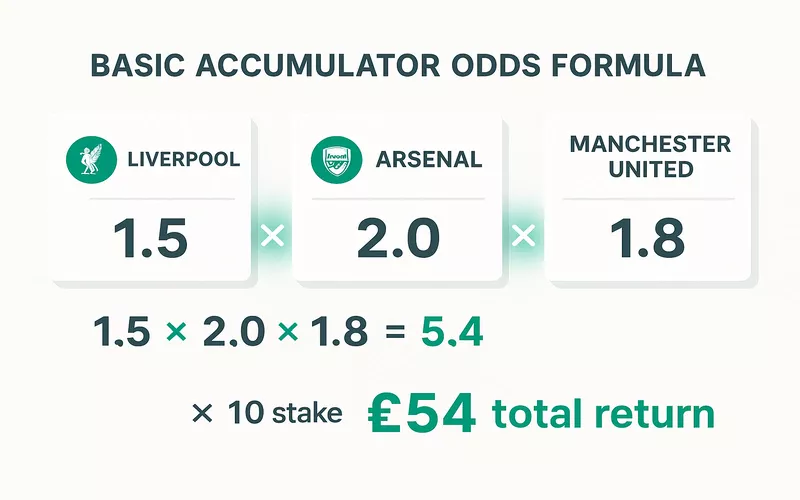
Let me show you with an actual example that’ll make everything crystal clear. Say you’re building a simple three-fold accumulator with these selections:
- Liverpool to win at 1.5 odds
- Arsenal to win at 2.0 odds
- Manchester United to win at 1.8 odds
Your combined odds are: 1.5 × 2.0 × 1.8 = 5.4
If you stake £10, your potential return is: £10 × 5.4 = £54
That £54 includes your original stake, so your actual profit would be £44. Simple as that.
Now, here’s where people start getting confused. They look at those individual odds-1.5, 2.0, 1.8-and think “those are pretty short odds, this bet’s basically guaranteed.” Wrong. Dead wrong. When you multiply them together, you’re not just adding them up. You’re compounding the risk.
Think about it this way. If Liverpool have a roughly 67% chance of winning (implied by 1.5 odds), Arsenal have a 50% chance (2.0 odds), and United have a 56% chance (1.8 odds), your chances of all three winning are 67% × 50% × 56% = about 19%. That’s roughly one in five. Not quite the “banker” it seemed when looking at each selection individually, is it?
This is the fundamental principle that makes accumulators so profitable for bookmakers and so treacherous for punters. The multiplication of odds looks attractive on paper, but the multiplication of failure probability is what actually matters. Understanding this basic formula is your first step toward intelligent accumulator betting.
Calculating Accumulator Odds with Decimal Odds (The Easiest Method)
Decimal odds are your best friend when calculating accumulators. Seriously, if you’re still using fractional odds for accumulator calculations, you’re making life unnecessarily difficult for yourself.
Why are decimals so much better? Because they’re designed for exactly this kind of multiplication. The decimal already includes your stake, so the math flows naturally. No conversions, no adding one, no head-scratching moments where you’ve forgotten whether to divide or multiply.
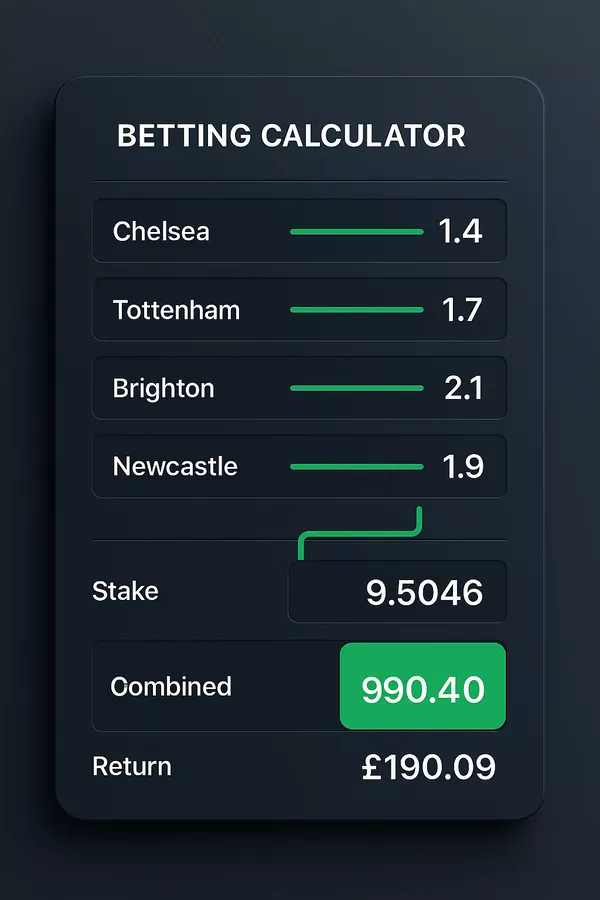
Let’s work through a proper example-a four-fold accumulator that you might actually place on a Saturday afternoon. You fancy these four teams:
- Chelsea at 1.4
- Tottenham at 1.7
- Brighton at 2.1
- Newcastle at 1.9
Step one: multiply all the odds together. 1.4 × 1.7 × 2.1 × 1.9 = 9.5046
Already you can see this is going to pay out decent money. Nearly 10 times your stake if everything comes in.
Step two: multiply by your stake. Let’s say you’re putting down £20. That’s £20 × 9.5046 = £190.09
That’s your total return. To work out your profit, just subtract your stake: £190.09 – £20 = £170.09 profit. Easy, right?
But here’s where it gets interesting. Most punters stop at this point, happy with their potential £170 profit. Smart punters go one step further and calculate the implied probability. To work out your actual chances of winning this accumulator, you need to convert each decimal odds to probability. The formula is: Probability = 1 ÷ Decimal Odds
So for our four selections:
- Chelsea: 1 ÷ 1.4 = 71.4% chance
- Tottenham: 1 ÷ 1.7 = 58.8% chance
- Brighton: 1 ÷ 2.1 = 47.6% chance
- Newcastle: 1 ÷ 1.9 = 52.6% chance
Now multiply these probabilities together: 0.714 × 0.588 × 0.476 × 0.526 = 0.105 or 10.5%
Your accumulator has roughly a one in ten chance of winning. Is that £170 profit worth the 90% chance of losing your £20? That’s the question you should be asking before you place the bet.
Let me show you a bigger example because these are the ones that really catch people out. Say you’re feeling ambitious and build an eight-fold accumulator. All relatively short odds-nothing crazy. Each selection averaging around 1.5 odds.
Combined odds: 1.5^8 = 25.6
Stick a tenner on it and you’re looking at £256 return. Sounds brilliant, doesn’t it? But calculate the probability and reality hits hard. Even if each team has a generous 67% chance of winning (implied by 1.5 odds), your chances of all eight winning are 0.67^8 = 3.9%. Less than four percent.
This is why bookmakers love promoting big accumulators. The numbers look seductive, but the mathematics are brutal. The key takeaway? Decimal odds make calculation simple, but don’t let that simplicity fool you into thinking the bet is simple too. Always calculate both your potential return and your actual probability of winning.
Calculating Accumulator Odds with Fractional Odds (The Traditional Way)
Fractional odds are the old-school British way of expressing betting odds, and plenty of punters still prefer them. Fair enough-there’s something satisfying about seeing 5/2 rather than 2.5. But when it comes to calculating accumulators, fractions are a proper pain in the backside.
The problem is that fractional odds don’t include your stake. They’re showing you the profit relative to your stake, not the total return. So you need an extra step in your calculation.
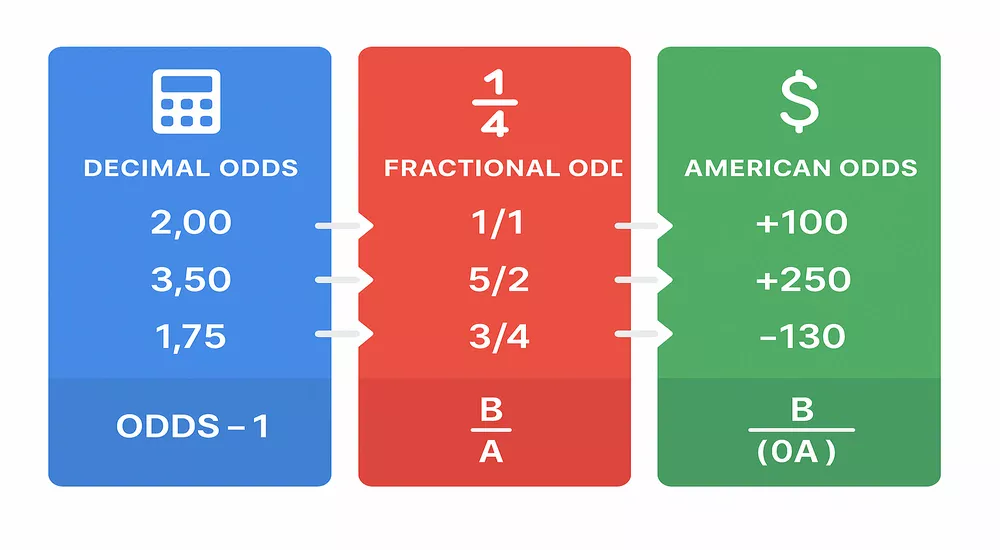
Here’s how it works. First, you need to convert your fractional odds to decimal. The formula is: Decimal Odds = (Numerator ÷ Denominator) + 1
Let’s work through it with a three-fold accumulator:
- Manchester City at 4/6 (four to six)
- Liverpool at 8/11
- Arsenal at 2/1
Converting to decimals:
- Man City: (4 ÷ 6) + 1 = 1.67
- Liverpool: (8 ÷ 11) + 1 = 1.73
- Arsenal: (2 ÷ 1) + 1 = 3.0
Now multiply: 1.67 × 1.73 × 3.0 = 8.66
With a £10 stake, your return is £10 × 8.66 = £86.60
See what I mean? You had to do all those conversions first. It’s not difficult, but it’s definitely slower than just working with decimals from the start.
Some old-timers insist on doing it the “proper” way without converting to decimals at all. Honestly? It’s masochistic. You end up multiplying fractions, adding one to each result, keeping track of multiple steps… it’s begging for mistakes.
Here’s my honest advice: if you’re comfortable with fractional odds and that’s how you think about value, fine. Keep using them for single bets. But when you’re building accumulators, just convert to decimals first. Your sanity will thank you. The one exception? If you’re doing this mentally-maybe you’re in the bookies and you want to quickly work out if a bet is worth placing. In that case, rough mental approximations with fractions can actually be faster. But for any serious accumulator with real money on it, convert to decimals and do it properly.
American Odds in Accumulators (For US Bettors)
American odds look absolutely mental to anyone who didn’t grow up with them. Positive and negative numbers, seemingly arbitrary values, the whole system appears designed to confuse. But if you’re betting in the US, you need to understand them.
American odds come in two flavors: positive and negative. Positive odds (like +200) tell you how much profit you’d make on a $100 bet. Negative odds (like -150) tell you how much you need to bet to win $100 profit. Yes, it’s backwards and weird.
To calculate accumulators with American odds, you first need to convert them to decimal odds. Here are the formulas:
For positive odds: Decimal = (American Odds ÷ 100) + 1
For negative odds: Decimal = (100 ÷ Absolute Value of American Odds) + 1
Let’s do a four-team parlay (that’s what Americans call accumulators):
- Patriots at -140
- Lakers at +180
- Yankees at -110
- Chiefs at +200
Converting each one:
- Patriots: (100 ÷ 140) + 1 = 1.71
- Lakers: (180 ÷ 100) + 1 = 2.8
- Yankees: (100 ÷ 110) + 1 = 1.91
- Chiefs: (200 ÷ 100) + 1 = 3.0
Multiply them together: 1.71 × 2.8 × 1.91 × 3.0 = 27.47
Stake $20 and you’re looking at $549.40 return. That’s $529.40 profit.
Now here’s where American sportsbooks get sneaky. Many of them don’t actually pay you at these true mathematical odds. They’ll apply what’s called “parlay pricing” which reduces your payout. Instead of getting 27.47 combined odds, they might only give you 25 to 1. They’re taking an extra chunk beyond the normal margin.
Why do they get away with it? Because most US bettors never calculate the true odds. They just accept whatever the sportsbook tells them. Don’t be that bettor.
The other weird thing about American odds is they make it really hard to assess value at a glance. A team at +500 is a massive underdog (6.0 in decimal). A team at -500 is a huge favorite (1.2 in decimal). But +150 to -150 doesn’t represent the same gap-that’s 2.5 to 1.67, much closer together.
This matters for accumulators because you need to understand the risk profile of each leg. Honestly, if you’re betting in the US and you want to get serious about accumulators, my advice is to either use a sportsbook that displays decimal odds as an option (some do), or just get really good at converting in your head. And for the love of all that’s holy, always calculate the true mathematical odds before accepting a parlay payout from a sportsbook.
Using an Accumulator Calculator (The Smart Shortcut)
Look, I’ve just spent several hundred words teaching you how to calculate accumulator odds manually. And that’s important-you should understand the mechanics. But in practice? Just use a calculator.
I’m not talking about your phone’s basic calculator app. I mean a proper accumulator bet calculator, designed specifically for this job. There are dozens of free ones online, and they’ll save you time, eliminate errors, and handle complex scenarios that would take ages to work out by hand.
Here’s what a good accumulator calculator should offer:
Multiple odds formats – You should be able to input decimal, fractional, or American odds and the calculator handles the conversion automatically.
Each-way calculations – If you’re doing an each-way accumulator (mainly for horse racing), a decent calculator will handle the place terms and reduced odds automatically. Trust me, you do not want to calculate each-way accumulators by hand.
Void selection handling – What happens if one of your selections is voided? A good calculator lets you mark it as void and recalculates your new odds.
System bet options – If you’re placing system bets like Yankees or Lucky 15s, you need a calculator that can handle multiple combinations.
Rule 4 deductions – In horse racing, when a horse is withdrawn, Rule 4 deductions apply to winning odds. Calculators that factor this in will save you from nasty surprises.
When should you use a calculator versus working it out yourself? Here’s my rule of thumb:
Use a calculator when you’re building anything more complex than a simple four-fold, when you’re placing an each-way accumulator, when you’re doing system bets with multiple combinations, or when real money is on the line and you want to be absolutely certain.
Calculate manually when you want to quickly assess if a bet is worth considering, when you’re in a situation where pulling out your phone would be awkward, or when you’re trying to understand the mathematics rather than just getting an answer.
The best approach? Learn to calculate manually so you understand what’s happening, then use calculators for actual betting. It’s like learning to do long division at school-important for understanding, but nobody’s expecting you to do it by hand when you’ve got a calculator in your pocket.
One word of warning though: not all online accumulator calculators are created equal. Some are outdated, some give incorrect results for complex scenarios, and some are covered in so many ads that they’re basically unusable. Test any calculator with a simple bet where you know the answer.
Accumulator Returns vs Single Bets (The Comparison That Matters)
Let’s settle this once and for all. Are accumulators better value than single bets? Spoiler alert: usually not.
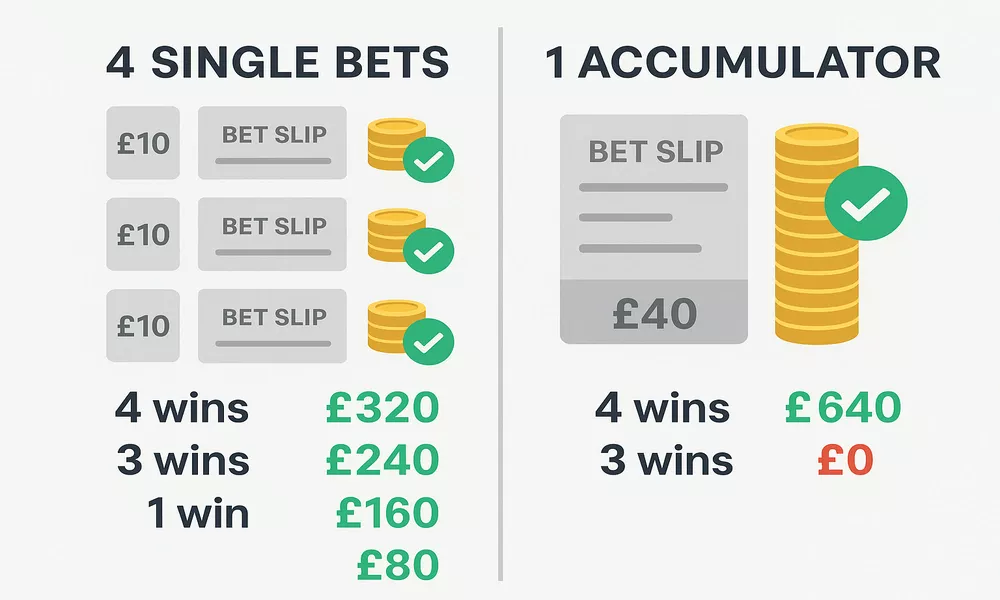
Say you’ve got four selections you fancy at 2.0 odds each. You’ve got £40 to bet. Two options:
Option 1: Four single bets at £10 each
If all four win: £80 return on each = £320 total
If three win: £240 return
If two win: £160 return
If one wins: £80 return
Option 2: One £40 accumulator
If all four win: £640 return
If three win: £0 return
If two win: £0 return
If one wins: £0 return
The accumulator pays more when everything wins, but that’s the only scenario where it’s better. In every other scenario, you’d prefer the singles.
But here’s the thing that really matters: expected value. If each selection genuinely has a 50% chance of winning (implied by fair 2.0 odds), you have four 50/50 shots. On average, you’ll win two of them with singles. Expected return: £160 from your £40 stake.
With the accumulator, probability of all four winning is 0.5^4 = 6.25%. Expected return: 6.25% × £640 = £40. Also break-even.
Wait, what? They’re the same expected value? Yes, in a perfectly fair market with no bookmaker margin, they are mathematically equivalent.
But we don’t live in a perfectly fair market. Bookmakers take a margin on every bet. And here’s the killer: that margin compounds in accumulators. The more legs you add to an accumulator, the more bookmaker margin compounds against you. This is mathematical fact.
Single bets give you more opportunities to win something back. Accumulators are all-or-nothing. From a pure value perspective, singles are almost always better.
So why do people bet accumulators? Because the potential return is exciting. Because watching five matches with a stake in all of them is more entertaining. Because hitting that big accumulator feels amazing in a way that grinding out small profits on singles never will.
Just go into it with your eyes open. You’re paying an entertainment premium for the thrill. That’s fine, as long as you know that’s what you’re doing.
Common Calculation Mistakes Bettors Make
I’ve seen some absolute howlers when it comes to calculating accumulator odds. Let’s make sure you’re not making any of these.
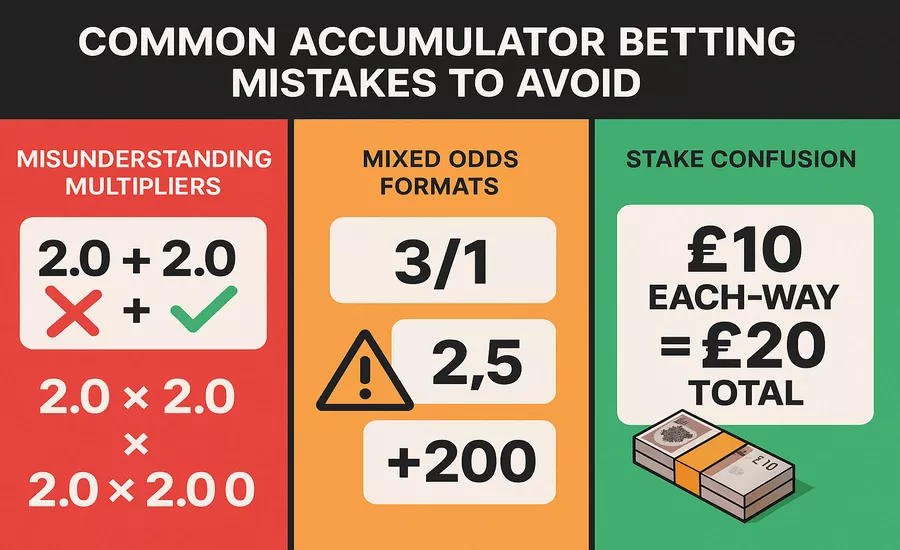
Mistake #1: Forgetting the stake is included in decimal odds – Someone sees 2.0 odds and stakes £10, then celebrates their “£20 profit.” No. You get £20 total return, which is £10 profit plus your stake back. I see this constantly with new bettors.
Mistake #2: Adding instead of multiplying – “I’ve got three selections at 2.0 odds each, so that’s 6.0 combined odds, right?” Wrong. It’s 2.0 × 2.0 × 2.0 = 8.0, not 2.0 + 2.0 + 2.0 = 6.0. Addition doesn’t work with odds.
Mistake #3: Mixing odds formats without converting – You can’t multiply 3/1 by 2.5 by +200 and expect a sensible answer. Convert everything to the same format first-preferably decimals.
Mistake #4: Miscalculating fractional to decimal conversion – The formula is (numerator ÷ denominator) + 1, not just numerator ÷ denominator. That “+1” is crucial because it includes your stake.
Mistake #5: Not accounting for each-way doubling your stake – “I’m doing a £10 each-way accumulator” means you’re staking £20, not £10. Your bet slip might show £10, but that’s per part. Always double-check the total stake.
Mistake #6: Ignoring void selections – If one leg is void, that leg disappears from your accumulator. Your five-fold becomes a four-fold. Your odds change. Don’t forget to recalculate.
Mistake #7: Trusting the bookmaker’s calculation without verification – Bookmakers make mistakes. Their systems glitch. Their odds compilers are human. Always verify the numbers yourself, especially on big bets or complex system bets.
The worst mistake though? Not calculating at all. Just blindly accepting whatever the bet slip says and hoping for the best. That’s not betting-that’s praying.
Accumulator Odds Psychology (Why Big Numbers Seduce Us)
There’s a psychological trap built into accumulator betting that you need to understand. Big numbers feel good. Really good. Your brain sees “potential return: £5,000” and immediately starts spending that money.
The problem? Your brain is terrible at understanding compound probability. When you see five selections that each have a “good chance” of winning, your intuition massively overestimates your chances of all five winning.
If I told you there’s a one-in-twenty chance of something happening, you’d think “yeah, that’s unlikely but possible.” But if I told you to build an accumulator where each selection has 70% chance of winning, and you need five of them, your brain thinks “five 70% chances, I’m probably going to win this.”
Nope. Five 70% chances multiplied together gives you 16.8% probability-almost exactly one in twenty. Your intuition was miles off.
This is why bookmakers display accumulator odds so prominently. They know the big numbers are seductive. They know you’ll see “£10 could win you £2,500” and think “why not have a go?”
Bookmakers also love showing potential returns in isolation. They’ll show you the £2,500 in big bold numbers. What they don’t show is “You have a 0.4% chance of winning this bet.” Because if they did, you’d realize you’re buying a very expensive lottery ticket.
The smart approach? Always calculate both the potential return AND the implied probability. Make yourself look at both numbers. Only then can you make a rational decision about whether the bet represents value.
And here’s a useful mental trick: flip the probability. If your accumulator has a 5% chance of winning, that means it has a 95% chance of losing. Would you take a bet with a 95% chance of failure? Probably not. But frame it as “5% chance of winning big” and suddenly it sounds exciting.
This is the psychology that bookmakers exploit. Don’t let them. Run the numbers, understand what you’re actually betting on, and make decisions based on math rather than emotion.
Calculate Accumulator Odds: Summary and How to Use the Formula in Practice
You now know how to calculate accumulator odds forwards, backwards, and inside out. You understand the basic formula, you can work with any odds format, and you know when to use a calculator versus doing it manually.
More importantly, you understand why the calculations matter. It’s not just about knowing your potential return-it’s about understanding your actual probability of winning, spotting when bookmakers are offering poor value, and making intelligent decisions rather than hopeful punts.
The key takeaways to remember:
Decimal odds are easiest for accumulator calculations-always convert to decimals if you’re working with fractions or American odds. The multiplication is straightforward and the results are accurate.
Your combined odds multiply together, but so does your failure probability. That’s the double-edged sword of accumulators. The potential returns look amazing, but your chances of winning collapse fast.
Always calculate both potential return and implied probability before placing any accumulator. If you’re only looking at the money you could win, you’re missing half the picture.
Bookmaker margins compound through each leg of your accumulator. The house edge on a four-fold isn’t four times the single bet margin-it’s worse. This is why bookies love accumulators.
Use calculators for complex bets, but understand the underlying math. You should know what the calculator is doing and why, even if you’re not doing it by hand.
Never trust a bet slip without verification. Bookmakers make mistakes, their systems glitch, and even when everything’s working correctly, you should know what you’re betting on.
The bottom line? Calculating accumulator odds isn’t difficult-it’s just multiplication. But understanding what those calculations mean for your actual chances of winning? That’s what separates smart bettors from mugs.
Master the math, understand the probability, and make informed decisions. That’s how you turn accumulator betting from blind hope into calculated risk. Not guaranteed profit-nothing in betting is-but at least you’ll know exactly what you’re getting yourself into.
Now get out there and calculate some odds. Just remember: if the numbers don’t add up to value, don’t place the bet.
See also: accumulator-bet – master accumulator betting.
See also: Common Accumulator Betting Mistakes – avoid costly errors with your odds.
Expertly verified: Mason Wright